IPTV vs Cable TV in the USA: Which Is Better in 2026?
IPTV vs Cable TV in the USA: Which Is Better in 2026?
Introduction
In the ever-evolving 2026 US television market, consumers have more choices than traditional cable alone. While cable television was once the only practical way to access live sports, news, and premium entertainment, a viewer may now choose between traditional cable, IPTV, individual streaming platforms, OTA television, or hybrid setups.
As traditional cable bills continue to rise, many Americans are asking a critical question: Is IPTV actually better than cable TV?
The answer is not a simple "yes" or "no." It depends heavily on your personal viewing habits, your household budget, the quality of your home internet connection, the devices you own, your sports needs, your channel preferences, and how much flexibility you desire.
While 4K IPTV USA offers a modern alternative with vast channel libraries and flexible streaming, we believe it's important to understand the fundamental differences between these technologies. In this guide, we will provide a balanced comparison to help you make an informed decision for your home entertainment setup.
Quick Answer: IPTV vs Cable TV
To give a concise answer, IPTV can be significantly more flexible, feature-rich, and internet-based, while cable TV can offer a traditional, familiar, provider-managed TV experience.
IPTV depends heavily on your home internet quality. If your internet is fast and stable, IPTV can deliver thousands of channels and VODs across multiple devices. Cable, however, may be preferable for users who want a traditional TV setup with a dedicated set-top box and prefer less dependence on their home internet connection for live television.
The better option ultimately depends on the user's priorities, technical comfort level, and infrastructure.
IPTV vs cable TV comparison for viewers in the USA in 2026
What Is IPTV?
IPTV stands for Internet Protocol Television. Instead of receiving television programs as broadcast signals through an antenna, satellite dish, or fiber-optic cable, you stream them over your existing internet connection.
This delivery method allows providers to offer Live TV over an internet connection, often paired with extensive on-demand content where available. You access IPTV using software known as IPTV players installed on Smart TVs, streaming devices (like Firesticks or Apple TV), smartphones, or computers. It is important to note that IPTV is simply a delivery technology. The legality of any specific service depends entirely on whether the provider holds the appropriate rights to distribute the content it provides.
Upgrade Your Viewing Experience with 4K IPTV USA Don't settle for buffering and low-quality streams. Choose a subscription that delivers true 4K quality, massive VOD libraries, and 24/7 VIP support. View 4K IPTV USA Pricing & Plans
What Is Cable TV?
Traditional cable television relies on a dedicated, physical cable infrastructure (usually coaxial or hybrid fiber-coaxial cables) connecting your home directly to the provider's network.
Cable companies typically require users to rent proprietary TV boxes to decode the signals and provide channel packages grouped into specific tiers. You get live television and, frequently, DVR functionality built into the provider equipment. It offers a traditional subscription structure where you pay a monthly fee, often bundled with internet and phone services, and navigate using a familiar remote and channel guide.
1. IPTV vs Cable TV: Cost
When comparing the cost of IPTV and cable, it's essential to look at the total structure rather than just the advertised base prices.
For IPTV, the total household expenses typically include the IPTV subscription itself, a compatible streaming device if you don't already own one, and a robust internet connection.
For cable TV, the expenses often include the monthly channel package, equipment rental fees for each TV box, DVR service fees, professional installation costs, and additional charges for premium channels or specific sports packages. Cable bills are also known to include various broadcast TV fees and local taxes where applicable.
While many users find IPTV more cost-effective due to the lack of equipment rentals and hidden fees, total household cost depends on the specific services and equipment you require. For transparent, flat-rate pricing, you can review the current 4K IPTV USA pricing to see how a premium service structures its costs.
2. Contract and Subscription Flexibility
Flexibility is a major deciding factor for many Americans in 2026.
Traditional cable providers frequently rely on long-term contracts. You might secure a promotional rate for the first 12 or 24 months, but breaking that contract early often results in hefty cancellation fees. When the promotional period ends, renewal terms frequently introduce significant price increases.
In contrast, IPTV services generally operate on prepaid monthly, quarterly, or annual subscriptions without long-term binding contracts. You pay for the time you want to use, making cancellation policies much simpler—you simply don't renew. However, users should always read actual subscription terms before purchasing any service to fully understand the refund and renewal policies.
3. Channel Selection: IPTV vs Cable
The way channel lineups are structured differs significantly.
Cable often organizes channels into traditional packages (e.g., Basic, Silver, Gold). If you want a specific international channel or a niche sports network, you usually have to upgrade to a much more expensive tier.
IPTV services may organize content into massive categories and playlists that include US channels, international channels, sports, news, entertainment, movies, and kids' programming, all in a single subscription. For example, exploring the 4K IPTV USA channels catalog reveals tens of thousands of live channels accessible without tiered upgrading, offering far more variety for bilingual households or international sports fans.
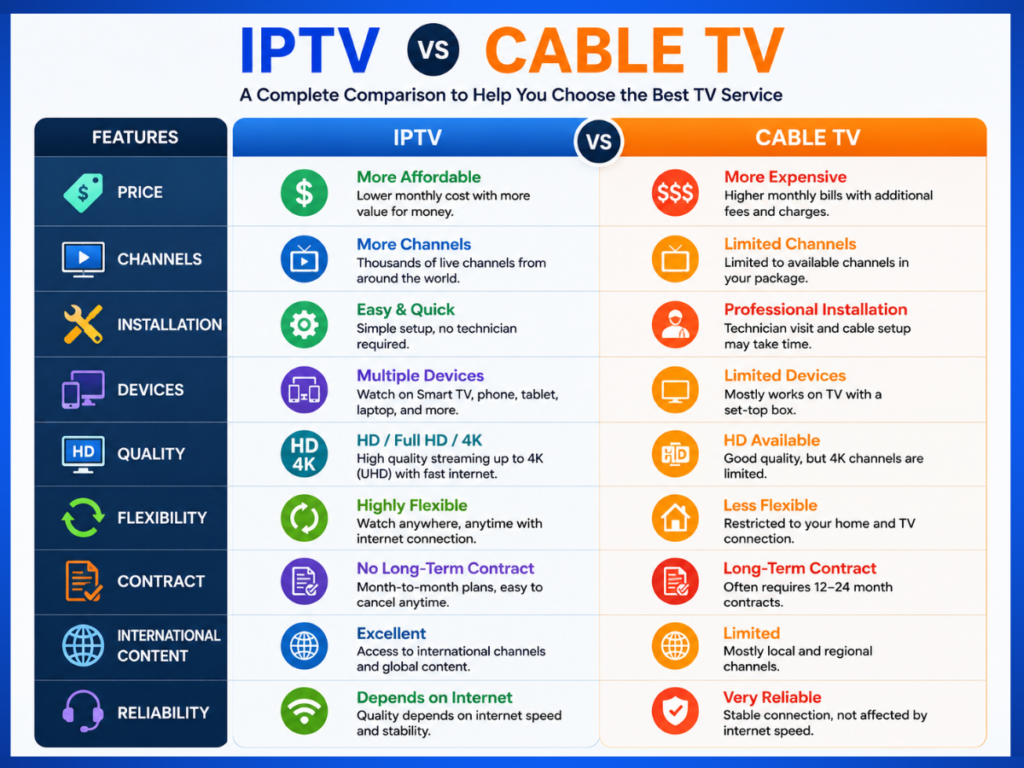
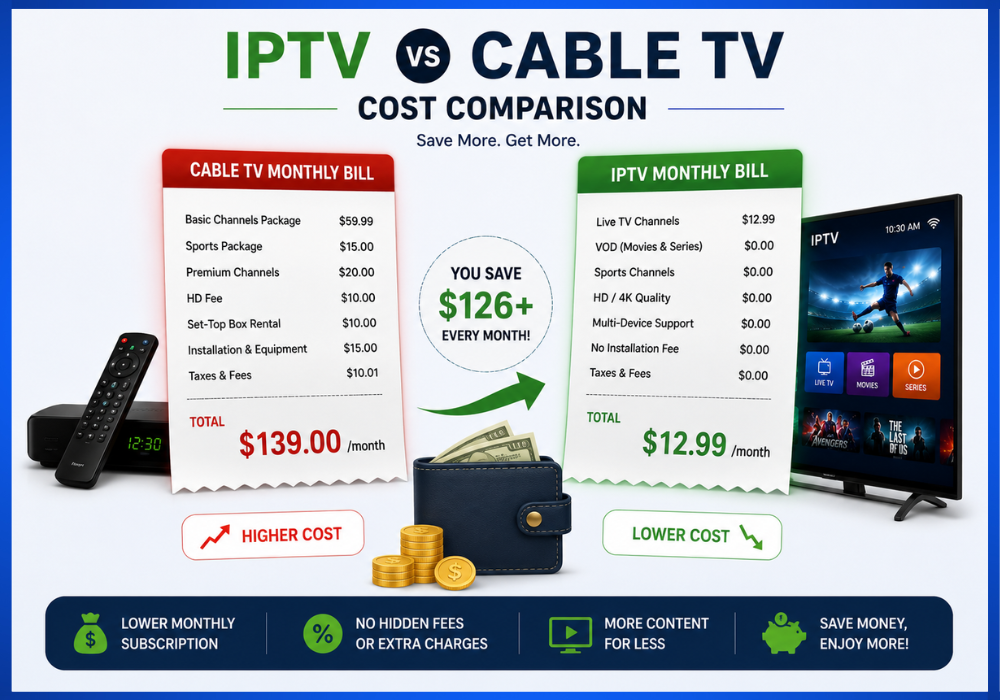 IPTV and cable TV features comparison including cost channels sports 4K and devices
4. Which Is Better for Live Sports?
Sports availability is a massive consideration. From a technical and user-experience perspective, both platforms have unique traits.
Cable provides dedicated sports channels with virtually zero latency compared to the live event. If you have a premium cable sports package, you get high reliability during major live events.
IPTV can provide an extraordinary breadth of global sports content, often including PPV events and international leagues that are impossible to find on local cable. However, sports availability depends entirely on the provider and their rights. For the best sports experience on IPTV, you'll want to verify if the streams support high framerates (60FPS where actually available) for smooth motion during fast action. It is also important to test peak-time viewing to ensure channel switching remains fast and streams do not buffer during major games.
5. IPTV vs Cable TV for 4K
4K resolution is heavily marketed in 2026, but availability and quality vary.
Cable 4K availability is still surprisingly limited in many areas, often restricted to specific on-demand movies or occasional special event broadcasts. The infrastructure limitations mean most cable channels still broadcast in 720p or 1080i.
IPTV 4K availability is generally much higher, with many services offering dedicated 4K channels and vast 4K movie libraries. However, 4K resolution alone does not guarantee better picture quality. Picture quality also depends on the source, the stream's bitrate, the compression used, the capability of your display device, and network stability. If you want to stream 4K IPTV smoothly, you must understand what internet speed you need for IPTV to handle the higher bandwidth demands.
6. VOD: IPTV vs Cable
On-demand viewing is critical for modern audiences.
Cable TV offers VOD through its set-top boxes. While the libraries contain movies and TV shows from the networks you subscribe to, the interface can sometimes feel sluggish, and content is often restricted to recent episodes or requires additional rental fees.
IPTV frequently includes massive, integrated VOD libraries containing thousands of movies and TV series, complete with catch-up features where available. A premium IPTV service offers sophisticated search functions, categorized libraries, and a Netflix-like browsing experience directly within the IPTV player.
7. Device Compatibility
Device flexibility is where IPTV truly shines.
Cable TV relies heavily on proprietary cable boxes and provider equipment. You generally need a box for every television in your house, hardwired into the wall.
IPTV may be used on almost any compatible screen with an internet connection. This includes Smart TVs, Android TV boxes, Google TV, Amazon Fire TV devices, Apple TV, smartphones, tablets, and computers. To see a full breakdown of supported hardware for our service, check out the 4K IPTV USA Installation guide.
Ready to Test 4K IPTV USA? Join thousands of satisfied customers and get instant access to 50,000+ live channels, 120,000+ films & series, and 200,000+ VODs. Secure your premium subscription today and enjoy buffer-free streaming. Choose Your 4K IPTV USA Subscription
8. Does IPTV Require Internet?
This is one of the biggest differences between IPTV and cable.
Yes, IPTV generally depends entirely on an internet connection. The television data is streamed in real-time over your Wi-Fi or Ethernet connection. The practical consequence is that if your internet connection becomes unavailable or unstable, your IPTV playback will instantly be affected.
Cable television does not require your home internet to function. It delivers traditional TV through the dedicated physical cable infrastructure. Even if your Wi-Fi router loses power, your cable TV will continue to broadcast as long as the provider's network is active.
9. Which Is More Reliable?
It is impossible to declare one universally better because they have different failure points.
IPTV can be affected by:
- Internet outages
- Wi-Fi interference or dead zones
- Local network congestion (e.g., someone downloading a massive file)
- Device processing limits
- IPTV player software bugs
- Stream-specific server issues
Cable can be affected by:
- Local cable outages
- Provider-wide outages
- Hardware failure (broken cable boxes)
- Physical damage to local infrastructure (e.g., fallen trees breaking lines)
Reliability depends entirely on your local setup, the quality of your ISP, and the specific TV provider you choose. If you are curious about testing an IPTV service's reliability, read our guide on how to test an IPTV service before buying a subscription.
10. Installation and Setup
Cable typically involves provider installation where a technician must visit your home, run coaxial cables, and activate the provider equipment. This can take hours and often incurs an installation fee.
IPTV installation is entirely digital and self-managed. You need an internet connection, a compatible device, and an IPTV player app. Once you purchase an account or receive a playlist (depending on the service), you simply log in and start streaming. For example, if you want to know how to set up IPTV on Android TV, the process usually takes less than five minutes.
11. User Experience and Navigation
The user experience can vary significantly between IPTV players and cable boxes.
Cable boxes offer familiar, traditional channel guides that most people have used for decades. They are straightforward but can sometimes feel dated and slow to navigate.
IPTV utilizes modern streaming apps. You get advanced EPGs (Electronic Program Guides), intuitive search functions, customizable favorites lists, rich VOD navigation, and categorized channel grouping. However, the experience depends entirely on which app you choose to use.
12. Multi-Device Viewing
With traditional cable, multi-device viewing usually means renting an additional cable box for every TV in your home.
With internet-based viewing, you can install the IPTV app on multiple TVs, phones, tablets, or streaming devices without renting extra hardware. However, you must carefully check simultaneous viewing rules. Most IPTV providers limit how many devices can stream at the exact same time under a standard account. Never assume you can watch on five TVs simultaneously without verifying the subscription terms.
13. Internet Requirements for IPTV
Since IPTV relies on data transfer, performance depends on available bandwidth, network stability, Wi-Fi signal strength, latency, and packet loss. A stream's bitrate directly dictates how much internet speed is consumed. While SD channels require very little data, 4K streams demand a robust connection. A household with multiple devices streaming simultaneously requires even more bandwidth.
14. What About IPTV Buffering?
Buffering is a known challenge for internet streaming. It can occur due to internet congestion, Wi-Fi interference, device limitations, player app issues, or stream-side problems at the server level. Cable TV does not "buffer" in the same way, though it can experience pixelation during bad weather or signal degradation. If you experience freezing on IPTV, it is usually fixable by following our comprehensive troubleshooting steps on fixing IPTV 4K buffering problems.
IPTV: Pros and Cons
IPTV Advantages
- Flexibility: No long-term contracts or credit checks.
- Internet-based viewing: Requires no physical infrastructure installation.
- Compatible devices: Works on Smart TVs, phones, tablets, and streaming sticks.
- Content: Potential access to massive live and on-demand content libraries globally.
- Mobility: Can often be used anywhere with a strong internet connection (where supported).
- Modern interfaces: Highly customizable apps with rich EPG and VOD layouts.
IPTV Disadvantages
- Internet dependency: Completely reliant on your ISP's stability.
- Network-related problems: Susceptible to Wi-Fi drops and buffering.
- Configuration: Requires some technical comfort to install apps and configure settings.
- Quality variance: Service quality can vary wildly between providers.
- Verification: Users must carefully verify provider legitimacy and terms.
Cable TV: Pros and Cons
Cable TV Advantages
- Traditional TV experience: Familiar, simple plug-and-play usage.
- Provider-managed infrastructure: The company maintains the lines and the hardware.
- Familiar channel guides: Easy for non-technical users to navigate.
- Independent delivery: Less direct dependence on home internet for the TV signal.
Cable TV Disadvantages
- Package structures: Forced to buy bundled tiers for specific channels.
- Equipment: Monthly rental fees for bulky cable boxes.
- Contracts: Potential long-term lock-ins and cancellation fees.
- Flexibility: Difficult to watch on mobile devices away from home without specific provider apps.
- Infrastructure limitations: Slower to adopt widespread 4K live broadcasts.
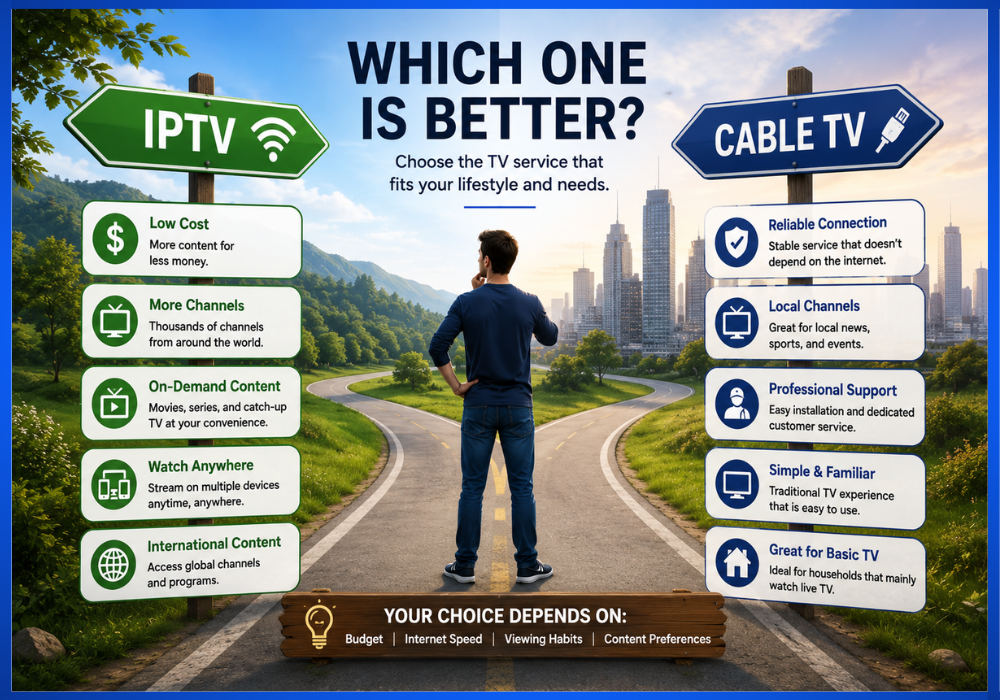 Choosing between IPTV and cable TV for a USA home entertainment setup
Who Is IPTV Better For?
IPTV may appeal to users who prefer flexible viewing without contracts, use Smart TVs and modern streaming devices, and want internet-based TV that spans global content. It is ideal for cord-cutters who watch on multiple compatible devices, want integrated access to live TV and VOD where offered, and prefer navigating through modern app interfaces rather than traditional cable boxes.
Who Is Cable TV Better For?
Cable TV may appeal to users who prefer a traditional television experience, want a provider-managed TV setup with dedicated technical support, and do not want their TV playback to depend on their home internet connection. It is also suitable for those who prefer familiar cable equipment and already have a bundled cable/internet arrangement that suits their budget.
Comparison Table
| Feature | IPTV | Cable TV |
|---|---|---|
| Delivery method | Internet | Cable infrastructure |
| Internet required for TV | Generally yes | Generally no |
| Live TV | Yes, where offered | Yes |
| VOD | Often available, service dependent | Often available, provider dependent |
| 4K | Service/device dependent | Provider/channel dependent |
| Smart TV support | Often available | Usually provider equipment dependent |
| Streaming devices | Often supported | Less central to traditional setup |
| Mobile viewing | May be available | Provider dependent |
| Wi-Fi impact | Can affect playback | Does not directly carry the traditional cable TV signal |
| Contract structure | Service dependent | Provider dependent |
| Installation | Usually internet + compatible device | Often provider equipment |
| Channel selection | Service dependent | Package dependent |
| Reliability | Depends on internet + service | Depends on cable infrastructure/provider |
What Does the Total Cost Really Look Like?
When deciding between the two, comparing only the advertised monthly TV price can be highly misleading. You must calculate the total ecosystem cost.
IPTV total cost includes: Your monthly home Internet bill + the IPTV subscription cost + any optional compatible devices (like a Firestick, purchased once).
Cable total cost includes: Your monthly home Internet (if purchased separately) + the base Cable TV package + monthly Equipment rental fees + DVR fees + premium/sports packages where applicable + local broadcast Taxes/fees.
By adding all these components together, you will discover the true monthly cost of your home entertainment.
Where Does 4K IPTV USA Fit Into the Comparison?
If you are exploring the internet-based route, 4K IPTV USA may be worth considering for users who prioritize massive channel variety, premium picture quality, and device flexibility.
Our service offers access to over 50,000 live channels and a massive VOD library of 200,000+ titles, including extensive sports coverage and international content. We support a wide range of devices—from Android TV to Apple devices and Firesticks—all without requiring you to rent proprietary hardware. We offer transparent pricing without hidden fees or long-term contracts, and a responsive support team available through our Contact page and FAQ section.
While it requires a stable internet connection to function optimally, our focus on anti-freeze technology and premium servers makes it a strong contender for those ready to embrace modern streaming.
Frequently Asked Questions
So, Which Is Better in 2026?
The right choice ultimately depends on the viewer.
Choose IPTV if you prioritize:
- Flexibility without long-term contracts.
- Internet-based viewing on Smart TVs and streaming devices.
- Modern viewing interfaces with rich VOD capabilities where available.
- Potentially broader device options without equipment rental fees.
- Access to a massive global variety of live TV and on-demand content.
Choose cable if you prioritize:
- A traditional, simple TV experience.
- Provider-managed infrastructure with local technicians.
- Less dependence on home internet for live TV delivery.
- Familiar cable equipment and bundled internet packages.
There is no universal winner. If you decide that the flexibility, massive content selection, and cost structure of internet-based TV fits your lifestyle, explore 4K IPTV USA today and experience the future of home entertainment.